
Size matters.
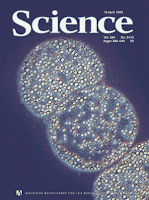
That's why there are no insects as big as horses [*], or bacteria as large as to be seen without the use of a microscope. Well, actually, the latter is not true —although a typical bacterial cell is not longer than 5 micrometers, a few species such as Thiomargarita namibiensis (left image) and Epulopiscium fishelsoni may reach a length of over 0.5 millimeters (500 micrometers); enough to become visible to the naked eye.
Big bacteria enjoy some advantages; for instance, they can not be swallowed by most predators (such as ciliates) that feed on smaller cells. But they also face important problems, especially those related to diffusion limitation. In general, bacteria obtain their food molecules by diffusion; for this reason, their cells need to maintain a high surface-to-volume ratio. Thiomargarita solves this problem by creating a huge central vacuole that fills about 98% of the cell volume, leaving only a thin layer of cytoplasm lining the cell wall. However, Epulopiscium appears to have a low surface-to-volume ratio (despite the presence of many invaginations of its cell membrane). This anomaly might be partially explained by the fact that Epulopiscium lives in the gut of a tropical fish, presumably a very rich medium (that is, a high concentration of nutrients may compensate their poor diffusion into a big cell). Additionally, this bacterium has some peculiarities that may be related to this issue: it reproduces by forming internal daughter cells (see figure below), and most of its DNA is arranged around the periphery of the cytoplasm.

 Remarkably, a recent article published on PNAS reports that each Epulopiscium cell has tens of thousands of copies of the genome. Because so far nobody has been able to culture Epulopiscium, the authors had to collect some tropical fishes (Naso tonganus, a unicorn fish) on reefs around Lizard Island, Australia. Then, they extracted the intestinal contents, and handpicked thousands of individual Epulopiscium cells with the aid of a microscope and a micropipettor (an automated device for pipetting microliter volumes). Finally, the researchers used quantitative PCR (Polymerase Chain Reaction) to enumerate the copy number of certain genes on individual cells and in DNA obtained from populations of cells. Epulopiscium large cells contained about 250 picograms (pg) of DNA (compare to 6 pg of DNA in a human diploid cell!), corresponding to several tens of thousands of copies of a ≈3.8 megabase genome.
Such an extraordinarily high number of genome copies per cell could be related to Epulopiscium evolution in a number of interesting ways. Given the biased distribution of DNA within the cytoplasm, these big cells might possess a functional compartmentalization. In the authors' words:
"In this way, a large bacterium could function like a microcolony, with different regions of the cell independently responding to local stimuli, which would alleviate some of the pressure to remain small for the sake of rapid intracellular diffusive transport."The article ends with:
"The enormous, polyploid Epulopiscium cell has converged on the advantages of social microbes but with additional benefits (exceptional motility, enhanced resistance to predation) normally found in large eukaryotic microbes or multicellular organisms."Epulopiscium: another fascinating microbe!
Original article:
Mendell, J.E., Clements, K.D., Choat, J.H., Angert, E.R. (2008). Extreme polyploidy in a large bacterium. Proceedings of the National Academy of Sciences USA, 105(18), 6730-6734. DOI: 10.1073/pnas.0707522105
Related links:
- Epulopiscium page, Angert Lab, Cornell University.
- Epulopiscium - MicrobeWiki, Kenyon College.
- MicrobeLibrary - Epulopiscium fishelsoni, American Society for Microbiology.
- Beyond Binary Fission: Some Bacteria Reproduce by Alternative Means. Microbe Magazine (March 2006).
- Thiomargarita - MicrobeWiki, Kenyon College.
- Fossil Caviar or Giant Bacteria?, Small Things Considered (March 3, 2007).
- Big Bacteria. Annu Rev Microbiol (2001) 55:105-37.
[*] Giant insects might reign if only there was more oxygen in the air, EurekAlert.
+++++++++++++++++++++++++++++++++++++++++++++++++++++++
Etymology of species names:
Epulopiscium = “guest at a fish's banquet”
(Latin epulo [sumptuous food, banquet] + piscium [of a fish])
fishelsoni = "of Fishelson"
(in honor of Lev Fishelson [Tel Aviv University, Israel], one of the discoverers of Epulopiscium)
Thiomargarita = "sulfur pearl"
(Greek thio [sulfur] + margarita [pearl])
namibiensis = "from Namibia"
Epulopiscium = “guest at a fish's banquet”
(Latin epulo [sumptuous food, banquet] + piscium [of a fish])
fishelsoni = "of Fishelson"
(in honor of Lev Fishelson [Tel Aviv University, Israel], one of the discoverers of Epulopiscium)
Thiomargarita = "sulfur pearl"
(Greek thio [sulfur] + margarita [pearl])
namibiensis = "from Namibia"
(Please correct me if I'm wrong)
+++++++++++++++++++++++++++++++++++++++++++++++++++++++
Image sources:
● Thiomargarita, at the cover of Science (April 16, 1999). The photomicrograph shows three cells under polarized light (middle cell is ~0.2 mm in diameter), and the small yellow spheres are sulfur globules that are restricted to the thin outer layer of the cell. Image: Ferran Garcia-Pichel.
● Life cycle of Epulopiscium. Reprinted by permission from Macmillan Publishers Ltd: Nature Rev. Microbiol. 3, 214-224 (2005). Copyright 2005.
● Thiomargarita, at the cover of Science (April 16, 1999). The photomicrograph shows three cells under polarized light (middle cell is ~0.2 mm in diameter), and the small yellow spheres are sulfur globules that are restricted to the thin outer layer of the cell. Image: Ferran Garcia-Pichel.
● Life cycle of Epulopiscium. Reprinted by permission from Macmillan Publishers Ltd: Nature Rev. Microbiol. 3, 214-224 (2005). Copyright 2005.
An article at ScienceDaily about the same PNAS report:
ReplyDelete'Shaquille O'Neal' Of Bacteria Big Enough To See With Naked Eye.
See also this post at MicrobiologyBytes (or listen to the podcast):
ReplyDeleteEpulopiscium, a giant among bacteria.